The Comfort of Trees

A woodland walk can calm our nerves, supercharge our memory and even help us sleep better. Cheryl Rickman gets to the root of why.

As William Wordsworth put it, trees can provide relief from “the fever of the world”. I find their strength, constancy and dependability comforting. It’s almost as if they whisper, “It’s okay. We are here.” But trees aren’t just a reassuring presence. Being around them can also improve our attention, help us sleep, speed up how we recover from stress and raise our cognitive ability – and it’s all down to science.

REBOOTING OUR NERVOUS SYSTEM
Trees produce a cocktail of botanical compounds, which soothe our autonomic nervous system. These compounds are a blend of essential oils called phytoncides and aromatic terpenes, which trees diffuse between each other to attract pollinators and protect themselves from bacteria, insects and fungi. Walking through woods, we breathe these in and absorb them through our pores. In response to this combination of phytoncide absorption and the soothing sights and sounds of the woodland, our nerves send electromagnetic signals to our brain – specifically to the hypothalamus – flicking the switch to shut down our “fight or flight” stress response and engaging the “rest and digest” calm response instead.

Switching off the stress response swaps cortisol and adrenalin production in our adrenal glands for happy hormones such as oxytocin and serotonin in our pituitary glands. Our breathing and heart rate slow, and stress and anxiety lessen. Our attention is restored. If we walk barefoot on the forest floor or sit beneath a tree and touch the earth, our bodies release even more feelgood chemicals. The bacteria found in soil – Mycobacterium vaccae – also activate the brain to produce serotonin, a neurotransmitter associated with happiness, calm and focus, and responsible for regulating mood, social behaviour and sleep. The effect of forest bathing (the Japanese practice of immersing yourself in the sights, sounds and smells of trees) on sleep is especially interesting and supported by research. In one study, forest health scientist Dr Qing Li and the Forest Therapy Study Group followed the sleep patterns of volunteers who undertook a 2.5km trail over two hours. The average sleep time of people in the group rose by an hour and 15 minutes (from just over six and a half hours to just under eight) on the night after the walk and 45 minutes on the one after that.

RESTORATIVE LANDSCAPES
Studies have also shown how much forests and parks, tree-lined streets and even images or videos of natural environments improve our emotional, cognitive and physical responses when we’re unwell or stressed.

In the 1980s, environmental psychologist Roger Ulrich conducted his “window view study” and found that patients treated in hospital rooms with a view of a tree or trees left hospital faster, had fewer negative evaluative comments in their nurses’ notes and took fewer strong analgesics than patients in rooms with a view of a wall.

In another study, Ulrich looked at whether a view of nature could help healthy volunteers recover from a stressful situation. After showing them intense videos of woodworking accidents, he measured their blood pressure, heart rates and sweat glands to determine their sympathetic nervous system activity (the system that controls our fight, flight or freeze response). Ulrich then asked half the group to watch a video of an urban scene and the other half to watch a video featuring a natural landscape with trees. The latter group returned to their baseline state within five minutes. The former group had only partially recovered after ten minutes.

FREEING UP OUR THOUGHTS
Trees also help us to focus. Spending even 20 minutes around them can boost our memory and concentration, catalyse creativity and open our mind to problem-solving. In a study led by researchers at the University of Michigan, people who walked around an arboretum performed 20 per cent better in a memory test the second time they took it compared to those retaking the test after strolling through the city, who showed no improvement.

And the more time we spend replacing tech with trees, the better. Four days of nature-immersion and a decrease in exposure to technology resulted in 50 per cent improvement in a creative problem-solving test, according to a study in the PLOS One journal.

In our regular life, where multiple demands compete for our attention, being around trees allows us to just be and to rest our befuddled brains. This enables us to engage in what environmental psychologist Rachel Kaplan calls “soft fascination”, where the landscape gently entices attention rather than demands it.

I love that gentle enticement of trees, that invitation to “Come, look, be still with us”. I always feel more reflective and more likely to daydream as I wander in the woods. Among trees, the sharp edges of life round off. Whether sheltered from the rain beneath their branches, leaning against their trunks supported by their strength or walking alongside them, the silent solace they provide gives me space to breathe in the sweet air of solitude, unfurl my thoughts and think things through. They give me permission to sit in silence, be myself and reboot.

EXTRACTED FROM Tree Glee: How & Why Trees Make Us Feel Better by Cheryl Rickman (Welbeck Balance, £16.99). Visit treeglee.co.uk to learn more.

Review
‘This lovely book is an absolute gem’ Joanna Lumley, Tree Aid Patron.

‘Trees are so important to our health and that of the planet. This inspirational book shows just how we can thrive together’ Alan Titchmarsh MBE

‘I have loved trees as long as I can remember, and Cheryl Rickman’s wonderful book illuminates the vitally important role they play, not only in maintaining the health of our planet and a habitat for so many living creatures, but also in providing us with mental and physical healing. Tree Glee also presents ideas on how you can help protect our amazing trees for the good of all’ Dr. Jane Goodall, DBE, Founder of the Jane Goodall Institute & UN Messenger of Peace

‘A blend of evocative nature writing, wellbeing advice and a call to action … This gorgeously illustrated book offers practical tips, exercises and thought-provoking reflections to help us engage with our natural habitat and become healthier and happier as a result’ The Lady

ALL ABOUT RECOLETA ATLAS

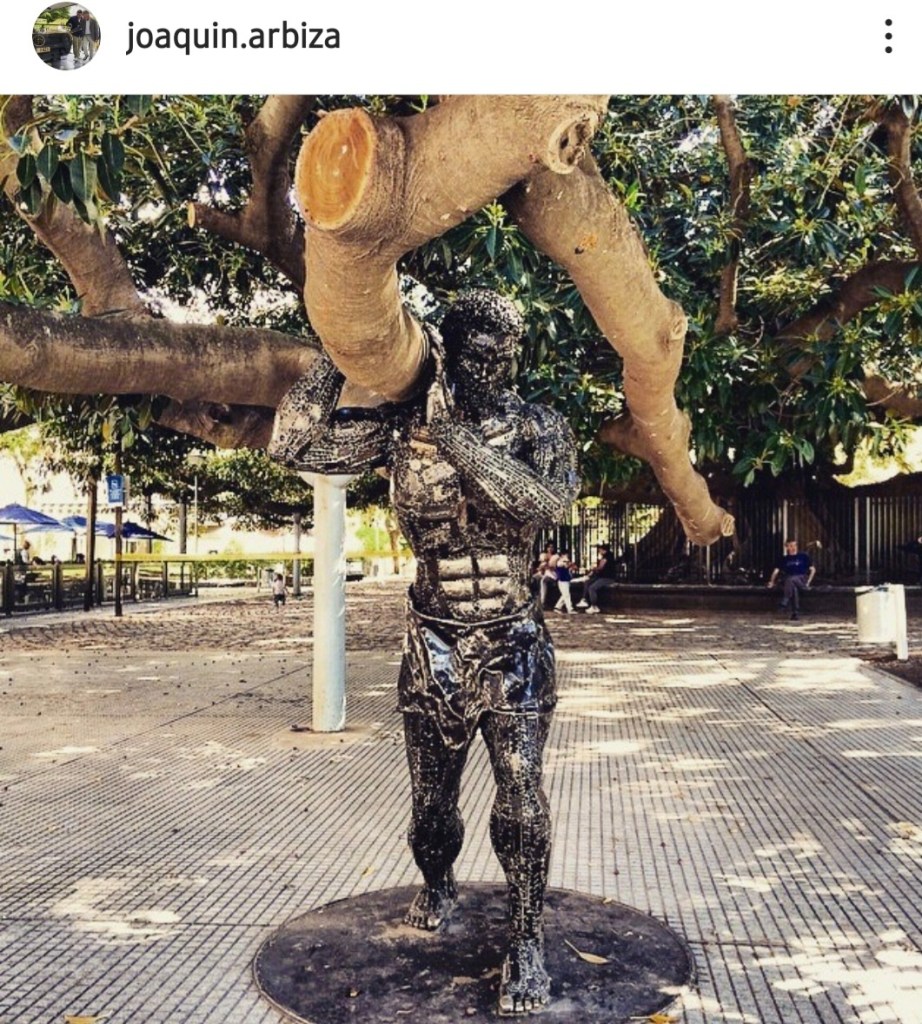
If you visit the Recoleta district, in Buenos Aires, you will certainly stop in front of the Atlas de Recoleta, this amazing sculpture supporting a tree branch.

THE ARTIST BEHIND RECOLETA’S ATLAS
Joaquín Arbiza Brianza is an Uruguayan sculptor. Self-taught artist very appreciated and talented, he developed his career between Europe and America. He generally makes his works with scrap metal, with a style that tends towards realism.

Arbiza does not work with molds either. So that it would be impossible for him to make an identical sculpture twice. This is how he learned his trade eight years ago, right after he finished his studies, when his mother’s passion for cars had already conquered him. That summer when he got down to building his own buggy, he did it, started it, drove it, and it only ran for fifty yards. Then, having no car to get around, he started building dolls with the leftovers. This is how his career began, of which the Atlas is an essential cog.

RECOLETA ATLAS
The work was inaugurated in 2014. It was offered to the city by its creator and represents the legendary titan of Greek mythology who carries on one of his shoulders a heavy branch of the monumental rubber tree. Recoleta’s Atlas is 1.85m tall, weighs around 250kg and rests on a circular iron base. It is made up of more than three thousand car parts, welded and assembled. It was the artist Arbiza who moved it. First in his truck, then by boat.

About his work, Arbiza tells us: “I started thinking about the importance of this tree, which represents a world of stories. Then the Atlas came to mind. I like the classics. I have many books on Greek and Roman cultures. And then I communicated with the people of the commune,” says Arbiza, 26, from Marindia, Uruguay, where he lives. His house is his studio, a space where he collects material for his works every day, which he finds, which is brought to him. The flesh of the Atlas. Muscles. The veins.

THE RUBBER TREE AND THE RECOLETA DISTRICT
Its scientific name is Ficus elastica, but it is also called gum tree or rubber tree. It is sometimes referred to as El Gran Gomero or Gomero de la Recoleta

It was probably imported from India.

His arrival in this district is not certain. Some say it was planted by the agronomist Martin Altolaguirre and others claim it was part of the park of the “Virreina Vieja” estate, Rafaela de Vera y Pintado, widow of Joaquín del Pino, viceroy of the Río de la Plata between 1801 and 1804″.

The Gomero has grown a lot over the years. The tree has a wingspan of 50m {164ft}, the trunk has a diameter of 1.5 m, the branches are 28m long and the tree is about 20m {66ft} high.

-The historic rubber tree is already part of the emblem of the Recoleta district, designed by the architect Fernando Ferreira.

References ~

https://instagram.com/joaquin.arbiza

http://www.aboutbuenosaires.org/news/strongest-man-supports-oldest-tree-buenos-aires/

The Saudi Green Initiative

The proportion of Saudi Arabia’s land area covered by forest has remained unchanged since 1990 at about 0.5%. Crown Prince Mohammed bin Salman, who aims to transform the petrostate’s economy and society, announced in late March 2021 a plan to plant 10 billion trees over the coming decades to increase by twelvefold the area covered by existing trees.

“The kingdom is determined to make a lasting global impact,” he declared.

The country also plans to work with other Arab states to plant an additional 40 billion trees across the Middle East.

However, large-scale projects modifying the natural environment should be done carefully, as human actions can ripple through the entire fragile desert ecosystem of Saudi Arabia. For example, change in local precipitations and soils can affect indigenous species of plants and animals.

China’s greening of a third of its Kubuqi Desert, which Saudi Arabia has studied, provides a model for restoring recently degraded land. Prince Mohammed’s plan appears to aim at restoring degraded lands but also to plant in areas previously not covered by trees.

“I don’t buy into this; the climate in Saudi Arabia is not going to change by planting trees,” said Nadim Farajalla‬, program director of the Climate Change and Environment Program at the Issam Fares Institute at the American University of Beirut. He told Al-Monitor trees are likely to be planted in urban and semi-urban areas to cool down the temperature.

Temperatures in Saudi Arabia are projected to rise faster than the global average in the coming decades. Also, research found that the Arabian Peninsula is likely to become uninhabitable by the end of the 21st century under a high-impact emissions scenario.

The Ghaf Tree Experiment

Planting 10 billion trees in a country that records the third-lowest precipitation worldwide raises concerns over the project’s feasibility, especially given the country’s track record on water management. Since the 1970s, the kingdom has depleted at a very fast rate its nonrenewable water trapped underground eons ago to develop a water-hungry agriculture sector.

The Minister of Environment said no groundwater or water produced in fossil fuel-powered desalination plants would be used to irrigate the trees. The project will rely on treated water and renewable water sources such as rainwater, seawater and cloud seeding.

The experience of Tatiana Antonelli Abella in the United Arab Emirates paves the way to tree planting projects in an arid climate. Observing that there is “no visual or cultural attachment” in the region to ice melting and the fate of polar bears, she launched the social enterprise Goumbook in 2009 to connect the “going green” discourse to local realities.

Then she started a campaign to plant Ghaf trees. Abella described the drought-tolerant tree — the UAE’s national tree since 2008 — as a “machine of survival” that taps water stored deep in the sand and requires only two years of irrigation when artificially planted.

Saudi Arabia would benefit from carefully researching what trees to plant, Abella told Al-Monitor. For example, the country could restore existing mangroves and plant mangrove trees that have huge advantages in terms of coastal protection and absorbing carbon dioxide. The Saudi minister of environment has stressed that local tree species will be favored.

“In terms of tree planting, the most important thing is always to look into what we have already existing rather than out of the blue creating new things,” Abella said.

At the back of the tree-planting program is Saudi Arabia’s renewed interest in the energy transition era in lowering its carbon footprint and positioning the country at the forefront of a global fight against global warming. The crown prince has said the Saudi Green Initiative’s projects would “reduce carbon emissions by more than (4%) of global contributions.”

The World Economic Forum launched in 2020 an initiative to grow, restore and conserve 1 trillion trees worldwide and said nature-based solutions can “provide up to one-third of the emissions reductions required by 2030 to meet the Paris Agreement targets.”

However, Farajalla said tree-planting is not a silver bullet and offsetting carbon emissions with trees is like “penny wise and pound foolish” given Saudi Arabia’s lack of commitment to reducing its volume of carbon emissions, which more than doubled between 2000 and 2015.

Like other Gulf oil producers, Saudi Arabia bets on producing the last drops of oil the world would consume. Environmentalists call on the region to accelerate its shift toward renewables to set an example of an economic transition away from hydrocarbon revenues.

“The number of 10 billion trees is mind-boggling,” said Farajalla.

He questions whether nurseries in the region can produce enough trees to complete the project. “If it takes 20 years to plant 10 billion trees, that means they have to plant around 1.5 million trees a day.” For comparison, the Let’s Make It Green campaign launched by Saudi Arabia in October 2020 planted 10 million trees over six months.

“Our nation trusts the government, so anything that the government does toward a green movement is definitely going to help people take the issue more seriously,” said Sarah AlTuwaijri, a Saudi citizen who is about to launch a vegan restaurant in Riyadh.

She told Al-Monitor that although more progress is needed, environmental awareness is on the rise as access to information is “not limited anymore” thanks to the internet and social networks.

Involving Saudis like AlTuwaijri in planting trees would help the society to reconnect to nature, a link that has gradually faded away as Saudis moved en masse from rural to urban areas. The percentage of the population living in an urban area has almost tripled since 1960.

If properly implemented, the plan is also an opportunity to provide long-term benefits such as jobs in the medicinal plant and ecotourism industries to rural communities, which still account for about 16% of the population. This would align with the prime objective of the crown prince’s reform plan Vision 2030 to develop a thriving non-oil economy.

13 million trees planted in the Kingdom during 2022 have been Mangroves. Approximately 100 carefully chosen species of native and adaptive trees are being cultivated in dedicated nurseries before being planted in 62 approved sites around the country to restore natural vegetation cover, protect biodiversity and bind the soil to protect against dust storms.

Detailed information and updates on SGI initiatives are on display at the SGI Gallery in Sharm El Sheikh.

Read more: https://www.al-monitor.com/originals/2021/05/saudi-arabia-plans-plant-10-billion-trees-desert#ixzz7qyaQJX5c

https://www.greeninitiatives.gov.sa/about-sgi/sgi-targets/greening-saudi/plant-10-billion-trees/

Walking Buffalo

Walking Buffalo (George McLean) age 92, near Morley, Alberta in 1962.

“Did you know that trees talk? Well, they do. They talk to each other, and they’ll talk to you if you listen. . . I have learned a lot from trees, sometimes about the weather, sometimes about animals, sometimes about the Great Spirit”.

Photo: Rosemary Gilliat / © Library and Archives Canada

Ancient Bristlecone Pine Forest

The Ancient Bristlecone Pine Forest is a protected area high in the White Mountains in Inyo County in eastern California.

The Ancient Bristlecone Pine Forest is home to the oldest trees in the world, bristlecone pines. Some of these living trees exceed 4000 years of age and exhibit spectacular growth forms of twisted and beautifully colored wood.

Beyond Schulman Grove lies the Patriarch Grove, 12-miles north on a good quality dirt road. Patriarch Grove is home to the world’s largest bristlecone pine, the Patriarch Tree. Its splendid remoteness and moonscape appearance gives the Patriarch Grove a surreal atmosphere. Bristlecone pines and limber pines dot the landscape with a background view of the Great Basin in Nevada.

The two groves are usually accessible when the winter snows have melted, between late May and mid November, and one full day is enough to visit both, and walk all the trails. The nearest town is Big Pine, 23 miles from the Schulman Grove and 6,000 feet below, with more facilities 15 miles north in Bishop.

The bristlecones grow together with limber pines (pinus flexilis), a more traditionally-sized species, also distinguished by its longer needles, which lack resin dots, and by its larger cones.

Visitors say they feel a sense of awe and peace when they walk the trails that weave through the groves of old and young bristlecones. The views out across the Owens Valley to the west and the Great Basin of Nevada to the east offer a perspective that cannot be seen anywhere else.

FIRE

On September 4, 2008, an arsonist set fire to the Schulman Grove Visitor Center and several bristlecone pines. The building and all the exhibits within were destroyed. Activities to rebuild the center began the next day and are now complete.

VISITING

* Schulman Grove and Schulman Grove Visitor Center – daily interpretive talks and natural history lectures mid-June through Labour Day, and hiking trails.
* Patriarch Grove – home of the world’s largest bristlecone pine, the Patriarch Tree, and a self-guided nature trail.

Life Visited Me

Patience visited me
And it reminded me
That good things take time to come to fruition
And grow slowly with stability

Peace visited me
And it reminded me
That I may remain calm through the storms of life
Regardless of the chaos surrounding me

Hope visited me
And it reminded me
That better times lay ahead
And it would always be there to guide and uplift me

Humility visited me
And it reminded me
That I may achieve it
Not by trying to shrink myself and make myself less
But by focusing on serving the world and uplifting those around me

Kindness visited me
And it reminded me
To be more gentle, forgiving and compassionate toward myself
And those surrounding me

Confidence visited me
And it reminded me
To not conceal or suppress my gifts and talents
In order to make others feel more comfortable
But to embrace what makes me me

Focus visited me
And it reminded me
That other people’s insecurities and judgements about me
Are not my problem
And I should redirect my attention
From others back to me

Freedom visited me
And it reminded me
That no one has control over my mindset, thoughts and wellbeing
But me

And love visited me
And it reminded me
That I need not search for it in others
As it lies within me.

Words by Tahlia Hunter

http://www.peacecompassionlove.com 💛

Thousands of trees planted by councils with £11m of taxpayers’ cash die after ‘rush job’ to prove their eco-credentials

  • Council data shows at least 80 councils fail to report the survival rates of trees 
  • Thousands of trees have been planted across England with £11m taxpayer funds
  • Some local authorities have reported survival rates below projected numbers 
  • A 2022 report showed 10 per cent of 6,000 trees planted in Lynnsport survived

Council data shows at least 80 local authorities are not recording if trees planted as part of a Government initiative to increase woodland in England and contribute to climate change are surviving, despite the huge influx of cash.

Some authorities have reported survival rates below projected numbers, despite expert opinion that survival rates should be between 90 to 95 per cent if the scheme is carried out properly with aftercare.

As a result, some have promised to replace the dead trees, which would require additional resources.

Andy Egan, Head of Conservation Policy for the Woodland Trust, told the Telegraph that local authorities are lacking the resources to care for their newly planted trees to ensure their survival.

He said the Woodland Trust is asking the Government to use the Environmental Improvement Plan to ensure ‘the long-term investment that’s needed’.

The 25-year plan aims to improve the environment by prioritising practices to ensure clean air, such as ending the sale of new petrol and diesel cars in the UK by 2040, using natural resources in a more sustainable way, minimising waste and managing exposure to chemicals among other pledges.

One of these includes pledging £9 million to plant trees in communities across England to introduce 30,000 hectares of new woodland annually by 2025.

The plan will report annually on its progress from this year onwards.

Last August, a report showed that 90 per cent of trees planted by West Norfolk Borough Council in Lynnsport died since being planted earlier that year, in April.

The 6,000 whips – young trees which have yet to grow branches – were planted in the area as part of the local authority’s drive to offset carbon emissions. However, the council later admitted many of the trees had died due to vandalism and a dry weather spell.

Conservationist Dr Charlie Gardner, visited the site in August and tested 150 trees, 135 of which had perished and 15 which he described as being in ‘a very bad condition’.

He claimed many trees had not bee properly planted into the ground. The trees that have been lost are due to be replaced next month.

Dr Gardner also visited a former waste site in King’s Lynn, Norfolk, where just 10 per cent of 6,500 trees are thought to have survived. He told the Telegraph that the ‘whole thing seems like a rush job, done for show instead of making sure it’s done properly.

Around 1,000 trees have now been replaced in the King’s Lynn site, according to the local authority.

Elsewhere, the Greater London Authority has no records on how many of the 430,000 trees planted since 2016 have survived, but has said lost trees will be replaced in three years.

And vandalism contributed to the destruction of trees planted by local businesses in East Staffordshire.

Richard Benwell, CEO of Wildlife and Countryside Link, said: ‘It’s vital that local authorities have the investment and expertise they need to plan, protect and maintain woodland and trees properly.’

In 2021, more trees were blown down by storms than were planted in England.

Devastation wreaked by Storm Arwen, which hit the UK on November 26 and 27, 2021, brought down 8,164 acres of woodland in England, a Forestry Commission assessment has found.

The storm accounted for the majority of the 8,278 acres of trees felled in total across England. But the area of trees created in 2021/22 in England was 5,585 acres, meaning more by area were lost than gained..

Reference ~ Gemma Parry for mailonline.